
engineering-board
io.github.GhostlyGawd/engineering-board
Documentation

Engineering Board
Repository pattern memory that helps an engineering agent find a root cause.
The board is the database.







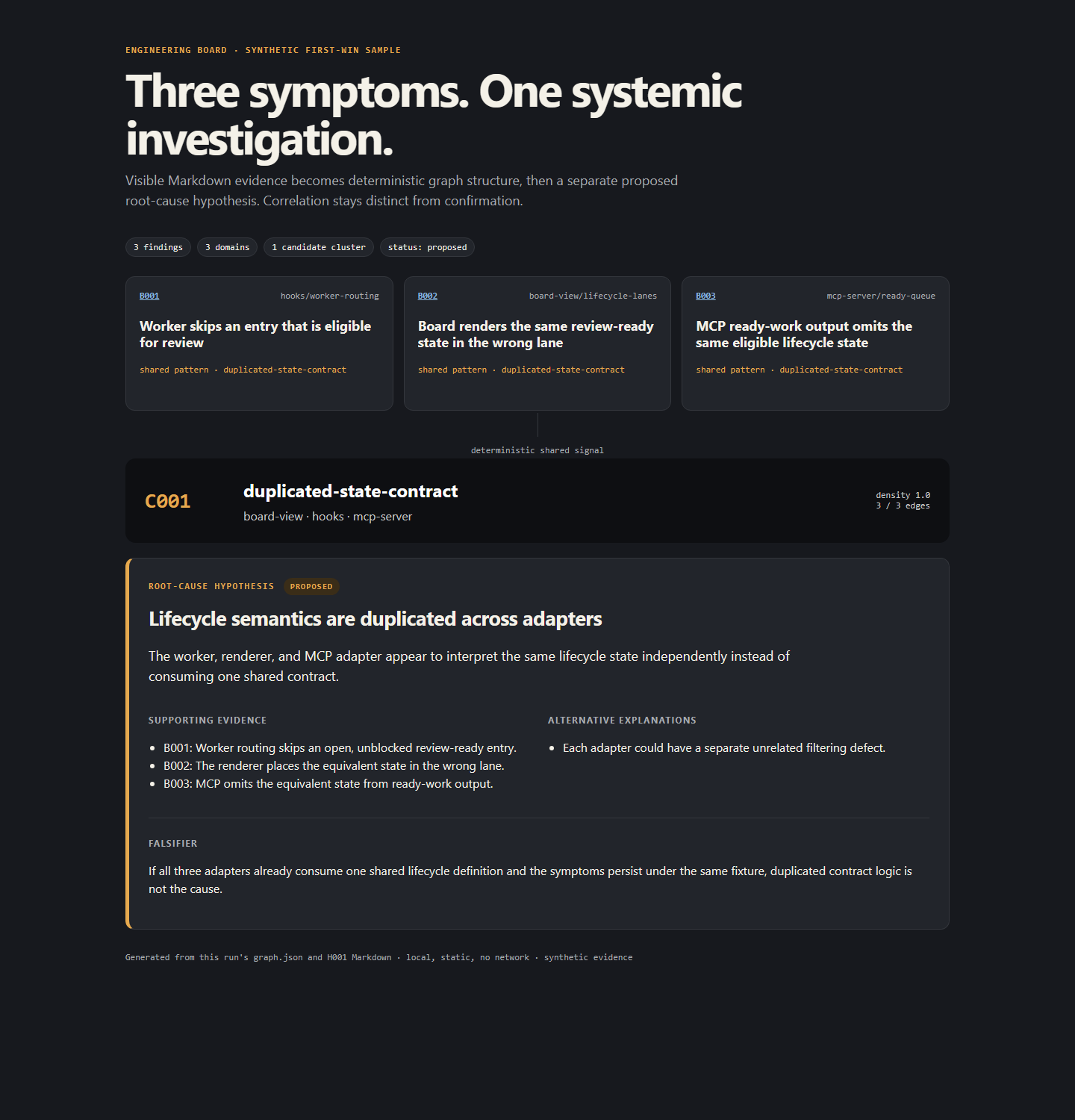
Run /board-demo to make this synthetic example.
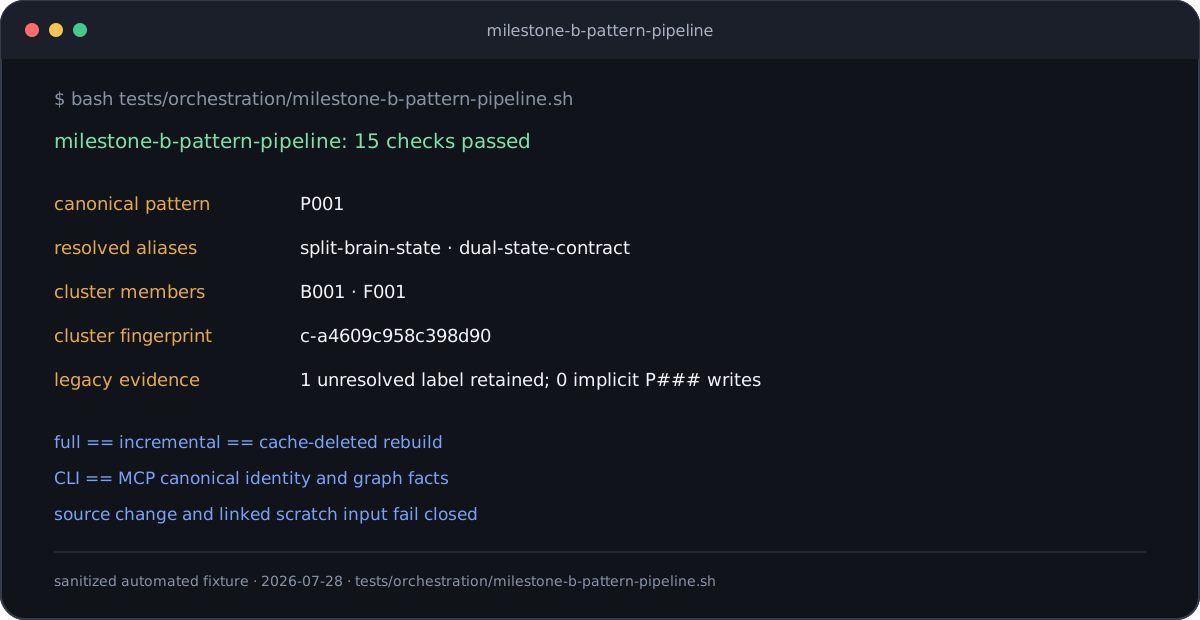
This visual shows real deterministic fixture output for the pattern pipeline.
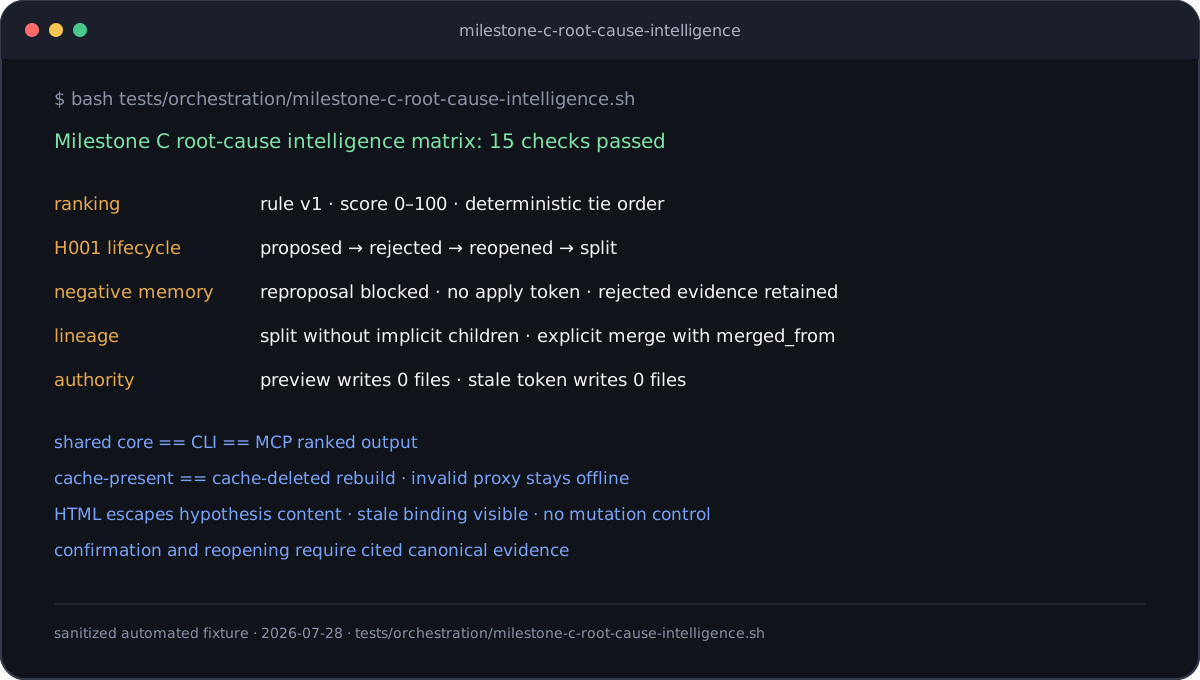
This visual shows real deterministic fixture output for root-cause memory.
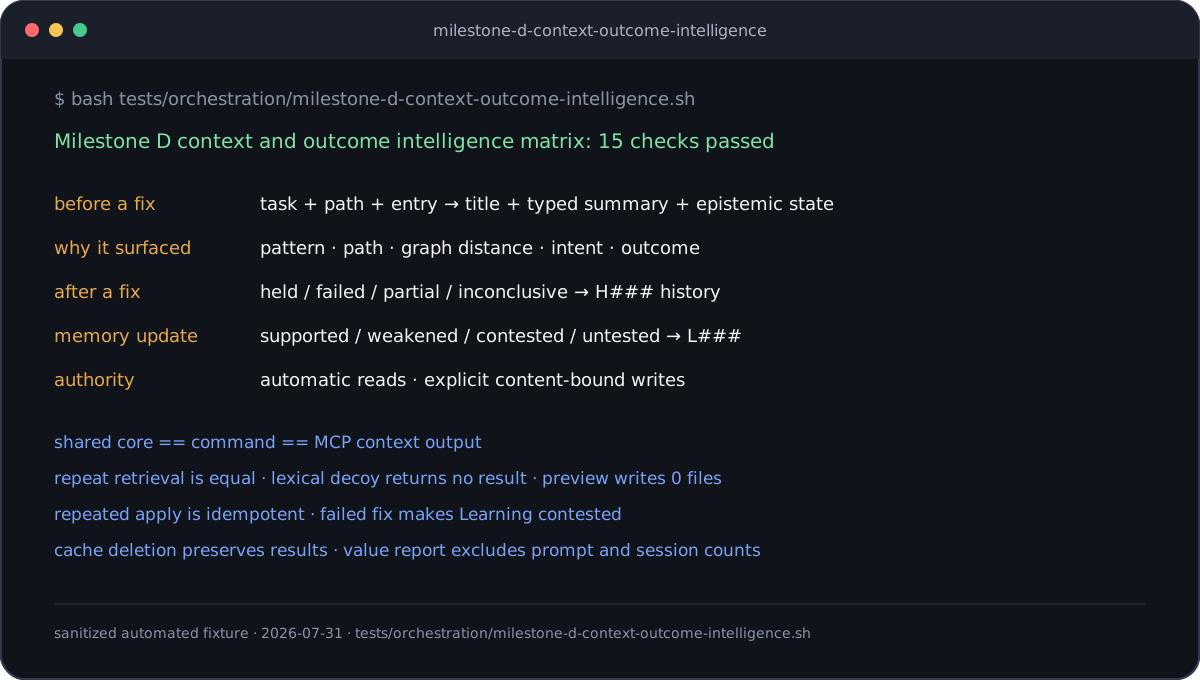
This visual shows the tested context-to-outcome memory loop.
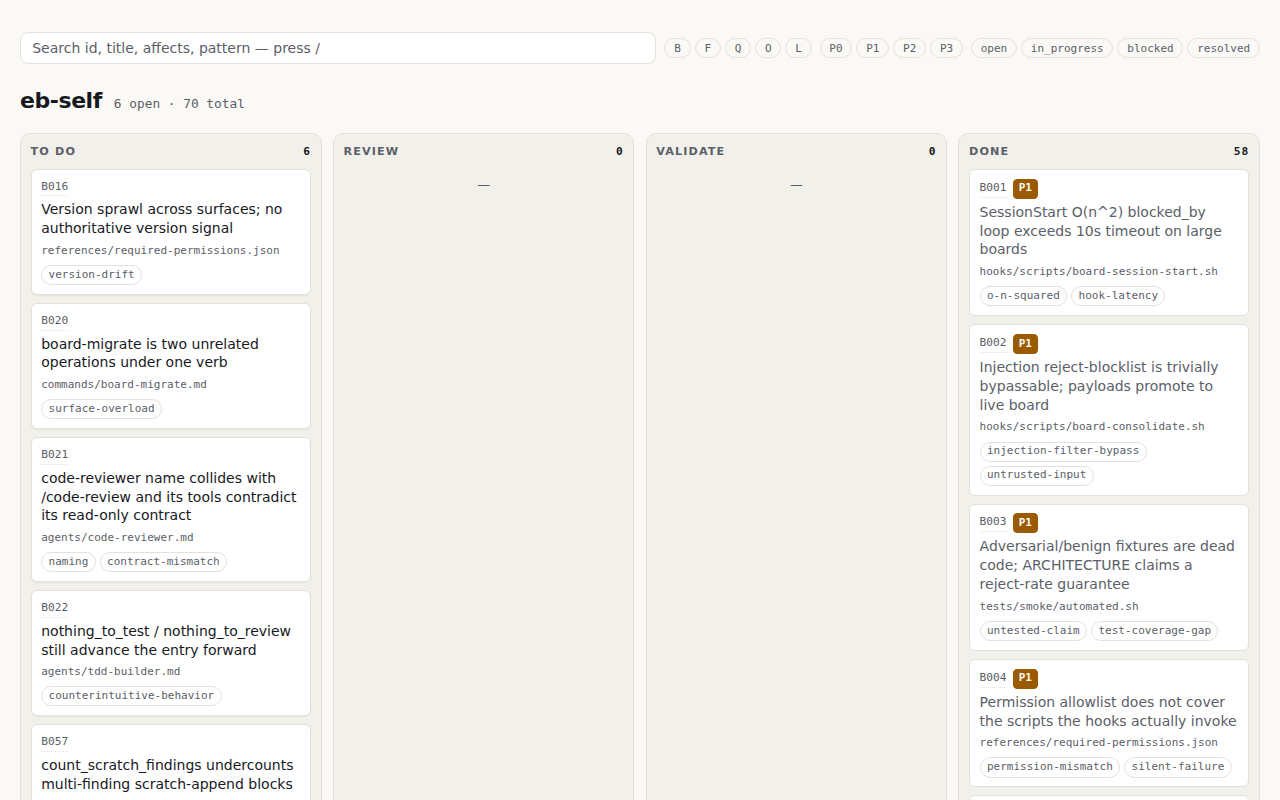
This repository uses its own Engineering Board.
Product description
Engineering Board is a repository-owned pattern-intelligence system for engineering agents.
The system records bugs, features, questions, and observations as Markdown evidence. It connects recurring findings in a deterministic graph.
The graph helps an agent investigate a shared cause across different domains. This method reduces repeated corrections of individual symptoms.
Markdown is the canonical record. A pull request can show each change to this record.
BOARD.md, GRAPH.yml, JSON analysis, and HTML are derived views. The system
can build these views again from the canonical record.
A hypothesis is separate from a deterministic graph fact. Only investigation evidence or fix evidence can confirm a hypothesis.
The optional tdd → review → validate loop can test a fix. This loop supports
the pattern memory, but it does not define the product.
Milestone C adds:
- A transparent investigation score from 0 through 100
- A durable H### hypothesis lifecycle
- Negative memory for a rejected claim.
Each score component is visible. A score does not prove that a cause is true.
Milestone D puts this memory in the agent's decision path:
board_contextretrieves relevant clusters, hypotheses, negative memory, and Learnings before the agent selects a fix.- Each result shows the structural signals, score components, reason, state, and canonical sources.
board_outcomesrecords an explicit fix result against an H### hypothesis.- Structured outcomes update Learning state and confidence through a separate preview and apply operation.
- A derived value report counts verified reuse and systemic fix evidence. It does not count prompts, sessions, or other activity.
Milestone D.1 adds a repository-only evaluation harness and eight sanitized
cases. The harness prepares 32 isolated baseline/context pairs, records bounded
evidence, and scores the accepted product-effect and false-positive gates.
The live paired evidence run has not started. The project does not yet claim
that the context improves agent diagnoses. See
evaluation/README.md for the proof boundary and
operator commands.
Product differences
Some Git boards show visible state but have little analysis. Some memory systems have useful analysis but keep the source outside the repository.
Engineering Board combines these properties:
- Repository evidence that a pull request can review
- A cross-domain pattern graph with evidence links
- H### records with alternatives and falsifiers
- Negative memory for rejected claims
- Atomic claims for parallel agents
- Passive capture
- A Claude Code plugin
- An MCP server.
Native Claude Code Tasks and Engineering Board have different purposes.
Native Tasks store personal task state in ~/.claude/tasks/. This state is not
part of a project pull request.
Engineering Board stores shared project memory in the repository. Use Native Tasks for temporary personal work. Use Engineering Board for durable project knowledge.
Install the Claude Code plugin
Add the repository marketplace:
/plugin marketplace add GhostlyGawd/engineering-board
Install the plugin:
/plugin install engineering-board
Set up a board:
/board-setup
/board-setup creates the board structure. It also checks the required
permissions.
Run the contained demonstration:
/board-demo
The command creates a synthetic run in
.engineering-board/demo/pattern-intelligence/.
The command connects three findings from different domains. It then requests one hypothesis that cites the evidence.
The hypothesis has status: proposed. It includes an alternative explanation
and a falsifier.
The report gives an exact cleanup command. The cleanup operation preserves a changed run.
For explicit setup values, use:
/board-init <project> [affects-prefix]
/board-install-permissions
Use the pattern-memory workflow
- Work in Claude Code.
- Let SessionStart and UserPromptSubmit retrieve relevant systemic memory.
- Run
/board-context <project>when you want the same bounded brief explicitly. - Investigate the cited cluster, hypothesis, negative memory, or Learning before you select a local fix.
- Let the Stop hook capture a finding in
engineering-board/<project>/_sessions/. - Run
/board-promoteto preview canonical changes. - Apply the unchanged promotion plan after you review it.
- Run
/board-insights <project>when you need the complete ranked investigation view. - Run
/board-hypothesis <project> proposeto preview an H### record. - Review the evidence, alternative, counter-evidence, confidence basis, and falsifier.
- Apply the unchanged hypothesis plan.
- After verification, run
/board-outcome <project> preview .... - Apply the unchanged outcome plan. Review and apply each returned Learning plan separately.
An outcome records held, failed, partial, or inconclusive. It can
confirm, weaken, reject, or leave a hypothesis unchanged only through a
compatible explicit disposition.
Use /pm-start only for advanced batch promotion. Use the optional Worker loop
only when you want to test a selected fix.
Use one session mode
/pm-start and /worker-start set
.engineering-board/session-mode.json.
A session can have one mode. Start a new session to change the mode.
On Claude Code web, each session uses a new clone. On a local installation, the mode file stays on disk.
To return to passive capture:
- Start a new session.
- Read the
SessionStartmessage. - If a mode remains, delete
.engineering-board/session-mode.json.
Register the MCP server
Register the PyPI package with the Claude Code command-line interface (CLI):
claude mcp add engineering-board -- uvx engineering-board-mcp
To run the server from a clone:
git clone https://github.com/GhostlyGawd/engineering-board
claude mcp add engineering-board -- python3 "$(pwd)/engineering-board/mcp-server/engineering_board_mcp.py"
For Claude Desktop, add this object to claude_desktop_config.json:
{
  "mcpServers": {
    "engineering-board": {
      "command": "uvx",
      "args": ["engineering-board-mcp"]
    }
  }
}
mcp-server/README.md also contains setup procedures
for Codex CLI, Gemini CLI, and Cursor.
The plugin registers the same server through .mcp.json.
Product surfaces
The plugin has four session modes:
| Mode | Start method | Stop action |
|---|---|---|
| Passive | Default | Run finding-extractor |
| Paused | /board-pause | Do not capture a finding |
| PM | /pm-start | Run the four PM agents |
| Worker | /worker-start --discipline <tdd|review|validate> | Claim and process one entry |
The canonical Stop procedure is
hooks/stop-hook-procedure.md.
Commands (21): /board-setup, /board-demo, /board-context,
/board-outcome, /board-promote, /board-pattern, /board-insights,
/board-hypothesis, /board-run, /board-init, /board-rebuild,
/board-graph, /board-view, /board-remember, /board-pause,
/board-resume, /pm-start, /worker-start,
/board-install-permissions, /board-claim-release, and /board-migrate.
Agents (8): board-manager, finding-extractor, consolidator, tidier,
learnings-curator, tdd-builder, code-reviewer, and validator.
Skills (5): board-intake, board-triage, board-resolve,
board-consolidate, and board-insights.
Hooks (4 events): SessionStart, PostToolUse(Write),
UserPromptSubmit, and Stop.
The MCP server has 19 tools. All tools use the same canonical Markdown and the same deterministic core.
| Tool | Function |
|---|---|
board_init | Create a project board |
board_list_projects | List router projects |
board_create_entry | Create a valid entry |
board_list_entries | List and filter entries |
board_get_entry | Get one entry |
board_update_entry | Change one entry |
board_graph | Build the deterministic graph |
board_context | Retrieve bounded and explainable systemic memory |
board_insights | Rank clusters and return linked evidence |
board_hypotheses | List, preview, or apply H### operations |
board_outcomes | Preview or apply fix outcomes and Learning feedback |
board_patterns | List, preview, or apply P### operations |
board_promote_findings | Preview or apply scratch promotion |
board_rebuild | Build BOARD.md again |
board_capture_finding | Add a finding to the scratch inbox |
board_claim | Acquire an entry claim |
board_release | Release an entry claim |
board_remember | Save a learning |
board_status | Show board state and ready work |
Architecture boundary
Canonical cards, hypotheses, Learnings, and BOARD-ROUTER.md use Markdown.
Derived views include BOARD.md, GRAPH.yml, context briefs, value reports,
JSON, and HTML.
The product does not require SQLite. A future SQLite index must be disposable and rebuildable. Measured query requirements must justify it.
The runtime uses Claude Code, bash, and python3. It has no runtime package
dependency.
Read ARCHITECTURE.md for the full system map.
Roadmap boundary
Milestone D ships in v1.11.0.
The cross-session Conductor remains a draft RFC. /board-run <entry-id> ships
only the single-session inner loop.
Cross-repository intelligence, hosted services, and a required database remain outside the current product boundary.
docs/PRODUCT_EVOLUTION_SPEC.md is the
authoritative product-direction source.
Contribute
Run the complete test suite:
bash tests/run-all.sh
The run-all command uses the maintained suite list. Read
CONTRIBUTING.md before you change the repository.
Support
- Use GitHub Discussions for questions.
- Use GitHub Issues for bugs and features.
- Use GitHub Security Advisories for a vulnerability.
- Use the live board for current project work.
- Use GitHub Sponsors to support the project.
GhostlyGawd maintains this open-source project.
License
The project uses the MIT License.
Language status
The owner approved the current controlled-English text. The project does not claim formal ASD-STE100 compliance, certification, or independent review.